
Union Mfg Co From New Britain to Boyertown a brief history
By Don Bosse
Historian, Union Mfg Co
The previous blog posts discuss the origins of the Union Manufacturing Company, which is to say, the “New” Union Manufacturing Company, which was founded by Robert Porter several years ago. This new company is a resurrection of the original Union Manufacturing Company that was founded in New Britain, Conn. on August 31, 1866, sort of, and I’ll get into that. For a better understanding of where it all began a quick review is necessary, so bear with me a moment while I provide the elevator version of the company’s history.
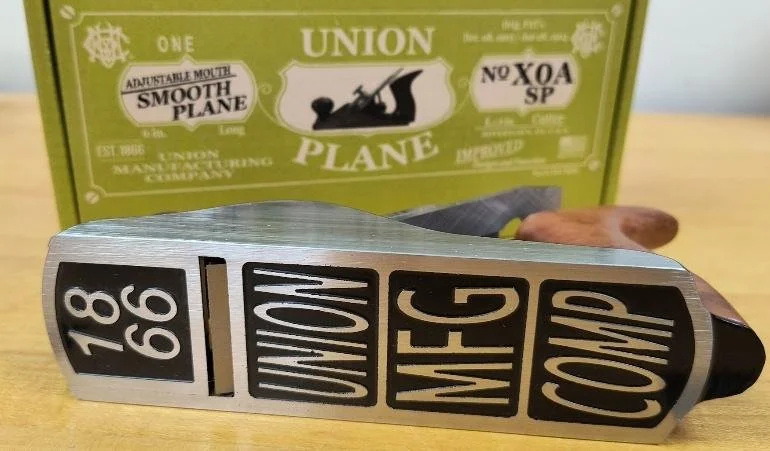
The new Union X0A SP pays homage to the founding of the company with the founding date and company name machined into the sole.
The incorporators of the original Union Manufacturing Co. reads like a who’s who of the most influential businessmen of New Britain’s hardware industries, Cornelius B. Erwin, Timothy W. Stanley, William H. Hart, Henry Stanley, and Augustus Stanley, are a few of the 37 incorporators. If you are a hand tool user, I am sure some of these names are familiar to you! The stated purpose of the company was, “The manufacture of Hardware, Casting Metals, finishing and converting the same into Merchandise, or any of the various articles of hardware which are or may be desired, and for the sale of same”, which essentially describes almost any type of product related to hardware and the manufacture there of. Which they did, casting iron products for other industries and for their own use, butts, hinges, and hardware, the machining of goods into finished products for the same, which eventually expanded into other lines of other goods, yard and cistern pumps, and chucks for lathes and machine tools, etc. They diversified to broaden their sources of income and provide economic stability for the company and employees.
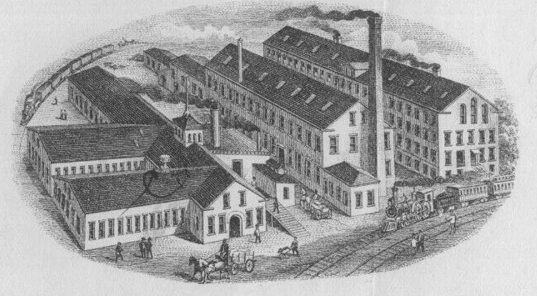
You may have noticed that planes and hand tools were not mentioned, those products were not added until 35 years after the company’s founding. Rather than start producing hand tools from scratch, Union entered the hand tool business through the purchase of the Derby Plane Mfg. Co. of Shelton, Conn. on January 8, 1901. The purchase included the tools, fixtures, machinery and all other assets of the company, which were moved to New Britain, and unbelievably, a line of woodworking planes was put on the market within six months of the acquisition! The Union Mfg. Co. was able to achieve this amazing fete because of their expertise in casting iron and in the manufacture of high-grade machine tools such as the chucks for lathes and drills, they had the experience and talent to back it up. The initial line of planes was based on the patents and patterns acquired from the Derby Plane Mfg. Co., the Derby B-Planes, which were “Bailey Pattern Planes”, meaning that they imitated the Stanley-Bailey line of planes produced by the Stanley Rule & Level Co. of New Britain, Conn. This style of plane is what the public wanted, and the reason why so many manufacturers’ planes look so similar.
The Union planes were good products whose quality improved through the investment of resources the Union Manufacturing Co. provided. But is good, good enough? Would you be satisfied with the status quo and being an also-ran manufacturer? Probably not. Which takes us to where this story gets interesting. At this point in time the superintendent of the Union works was John W. Carleton, who also served as the Fire Chief of New Britain, a well-known and respected member of the community. He was also a member of the Free-Masons, Harmony Lodge of New Britain, and as fate would have it, so were a number of the key players at the Stanley Rule & Level Co., Christian Bodmer (46 tool patents), Samuel and Yeaton Stearns (Stearns rules lineage), James M. Burdick (Supt. of Stanley), Charles B. Stanley (Sec’y & Tres. of Stanley), and of course the Patent King of New Britain Justus A. Traut along with his two sons! If you were rubbing elbows with these guys, wouldn’t you feel a bit pressured to put your mark on the tool world?
And so, it happened. Sometime in late 1902 John W. Carleton developed an improved method of securing the adjusting bolt (screw) that secured the plane-iron, the patent for which was granted Dec. 8, 1903. At the same time, he had teamed up with one of the toolmakers at the Union works, George E. Trask, and the two of them developed a brand-new method for holding and adjusting plane-irons. Which resulted in a patent being granted on the same day as the previous patent for a new style of bench-plane. This new plane design became what is now known as the Union X-Plane. This same design was improved by Carleton and Trask later that same year with the addition of counter locking nuts, and this improvement was granted a patent on June 28, 1904.
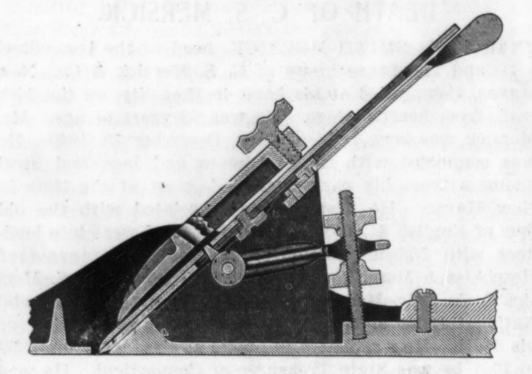
Advertising cut from the April 1904 Iron Age magazine.
Production for this new line of planes was announced almost immediately on Dec. 11, 1903, however, advertising for them in the trade magazines did not start to appear until June of 1904. As mentioned earlier, it took just six months for the Union Mfg. Co. to start producing planes once they had purchased the Derby Plane Mfg. Co., and the roll-out of the X-Planes appears to have taken at least a year before they were put on the market. This seems to indicate that there were some challenges in their production that needed to be ironed out. X-Planes as it turns out are a bit more challenging to produce than one would expect.
The Union X-Planes were well received, especially by the manual training schools, whose students found the planes easier to adjust and keep set. Which says a lot about the merits of their design, if beginner woodworkers benefited from their use so could experienced craftsmen. It all sounds too good to be true, and as fate would have it time changes everything. In 1906 the Union Manufacturing Co. was under new leadership, and this was the age of machines. The demand for machine tools and especially Union’s lathe and drill chucks to meet the needs of the machine age prompted the company to refocus the on its core business of producing chucks and iron castings for machines. Rather than abandon plane making, Union entered into a contracted agreement with the Stanley Rule & Level Co., where Union would furnish the castings for their planes and Stanley would perform the finishing work. Union would still market their own planes under this arrangement and continued to do so for 16 years until Oct. of 1922, when the hand tool business of the Union Manufacturing Company was spun off as the Union Plane Co., and was sold to the Stanley Works.
This was post WW I, and there was a great deal of overproduction after the war causing many industries to cut back, this along with the advent of modern electric woodworking machines and tools, spelled the end of the Union X-Planes. Stanley already had many successful lines of hand planes, continuing the X-Planes in a narrowing market did not make good business sense, and by this point Union had ceased production of them. The last known advertisements for the Union X-Planes appeared in the 1920 Montgomery Wards tool catalog, the X-Planes were marketed under the Wards brand name of “Lakeside.”
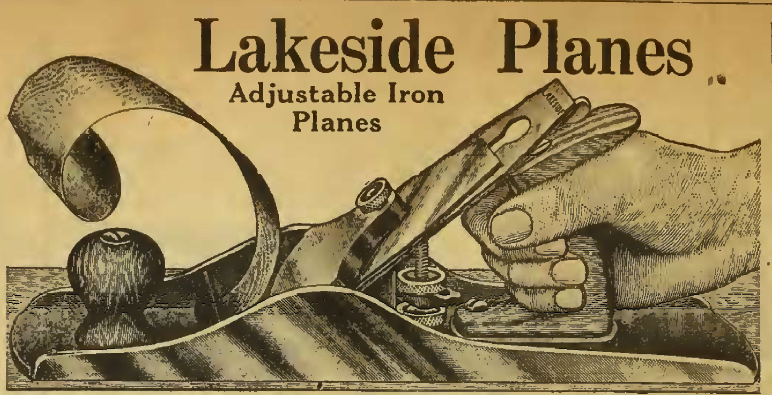
The last advertising for the Union X-Planes, Montgomery Wards catalog No. 93.
Ok, so fast forward to the present, I refer back to the two previous blog posts detailing how Robert Porter brought the new Union Manufacturing Co. back to life. Which leaves out some critical aspects of the challenges involved in doing so, there was no acquisition of an existing company’s assets, just a name, a logo and design, no large factory, no machines, no tooling, no patterns, no staff of talented moulders and machinists, just a guy with a dream and a desire starting out of his one car garage. But if Hewlett Packard started this way, why couldn’t he, right?
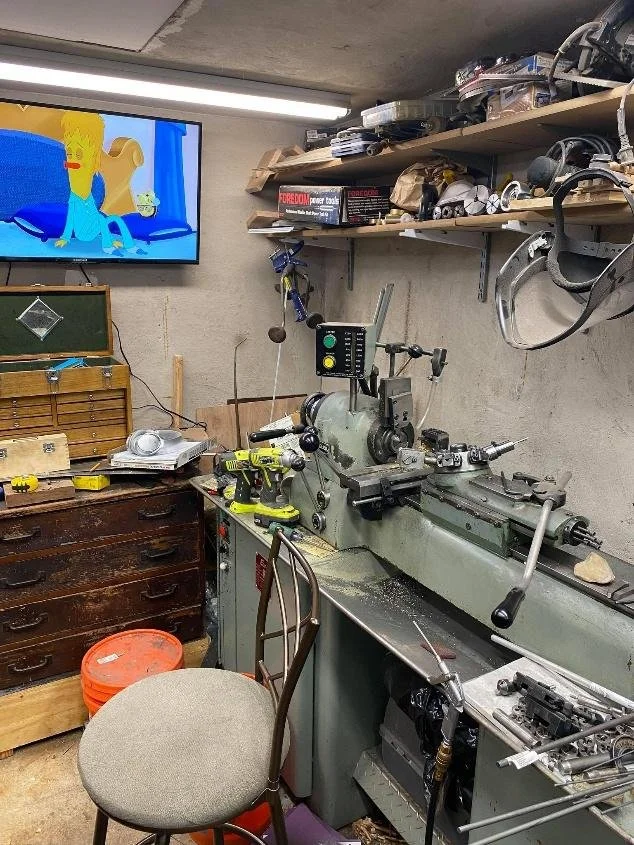
The birthplace of the new Union Manufacturing Company.
(check out the Hewlett Packard story here https://www.hpmuseum.org/garage/garage.htm)
To say there wasn’t a learning curve along the way would be the understatement of the century! During his journey Robert has had to learn CAD design, Pattern Making, Foundry Practice, Machining, Metal Finishing, CNC and Machine Code, that’s at least six separate trades! However, I would be hard pressed to name anyone else I know who could have overcome the adversities encountered along the way and still be in the game. He is determined to press on and deliver the goods with unprecedented attention to design, details, and quality. It takes a special kind of tenacity (and stubbornness) to have taken his dream this far. Is good, good enough for Robert Porter, NO, absolutely not, he has no intentions of being an “also-ran” manufacturer. I expect to see some great things coming from this company and the woodworking world will be all the better for it. In the end he will be able to rub elbows with the big boys and speak proudly of his accomplishments.
And that my friends, is my elevator version of Union history, perhaps the Empire State Building elevator, but that is as short as you will get from me. My only advice for Robert is, next time, take the elevator to success, not the stairs!
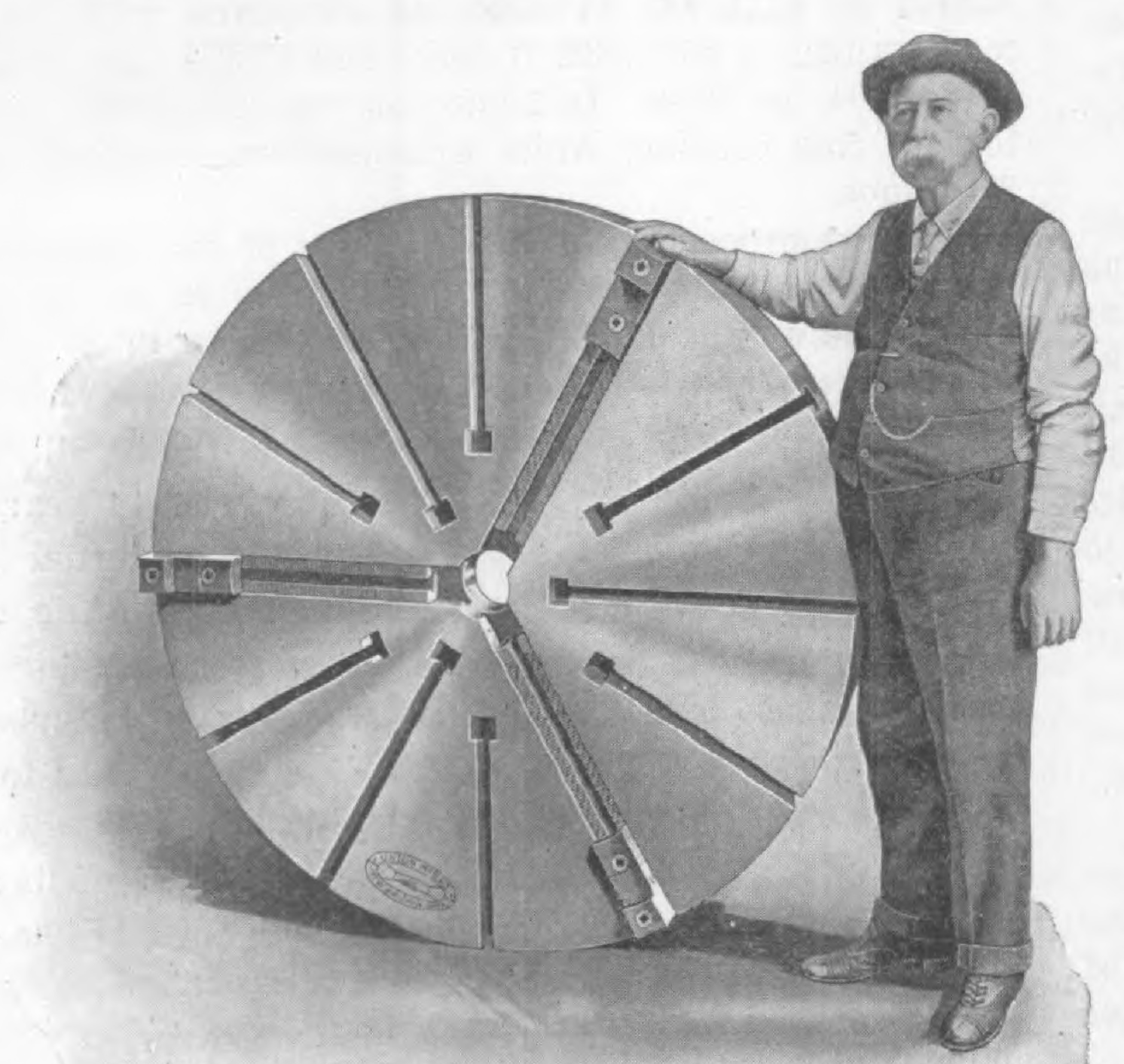
John W. Carleton, co-inventor of the Union X-Plane, standing next to a 5' wide Union lathe chuck.